Showing posts with label Film Studies. Show all posts

Tuesday, September 24, 2013

Rolling with the Changes, or How to Keep Our Violent Nature at Peace


Horror movies exist in order for people to deal with the inevitability of death. The cold hand of Death will one day grip each of us, and it is through the artistic expression of the horrific that we are able to process and attempt to resolve our feelings about our demise. 2011’s horror film The Cabin in the Woods (dir. Drew Godard) looks under the hood of cinematic horror fiction to show us why we need horror stories and what is wrong with the current generation of horror movies.

The Cabin in the Woods begins with a cliché setup: a group of friends (3 guys, 2 girls) plan to get away together and enjoy some R&R in a cabin in the middle of a wooded area. We’ve seen this story a million times, of course, in horror films dating as far back as 1972’s The Last House on the Left and 1974’s The Texas Chainsaw Massacre. This doesn’t even begin to consider the rise of teen exploitation horror flicks starting with 1980’s Friday the 13th. But, The Cabin in the Woods takes this familiar tale and spins it in a different direction…downward.

The film’s biggest twist involves the introduction of two unique characters, Sitterson (Richard Jenkins) and Hadley (Bradley Whitford). These are ordinary working joes who just so happen to work in an underground control room, orchestrating the events affecting the teenagers in the traditional tale. Sitterson and Hadley manipulate the environment to maneuver the teens into death situations. They are quite successful, and one-by-one the teens die at the hands of a redneck clan of zombies. This is all due to an elaborate ritual that must occur periodically to sate the “old gods,” whom, without the ritual, would rise up to destroy the earth.

One of the major themes of The Cabin in the Woods is the idea that we seek the voyeuristic thrill of watching murder and death to keep our violent nature in check. The film’s most pivotal, and memorable scene – the “Roll with the Changes” party scene – expresses this idea with a disturbing force.

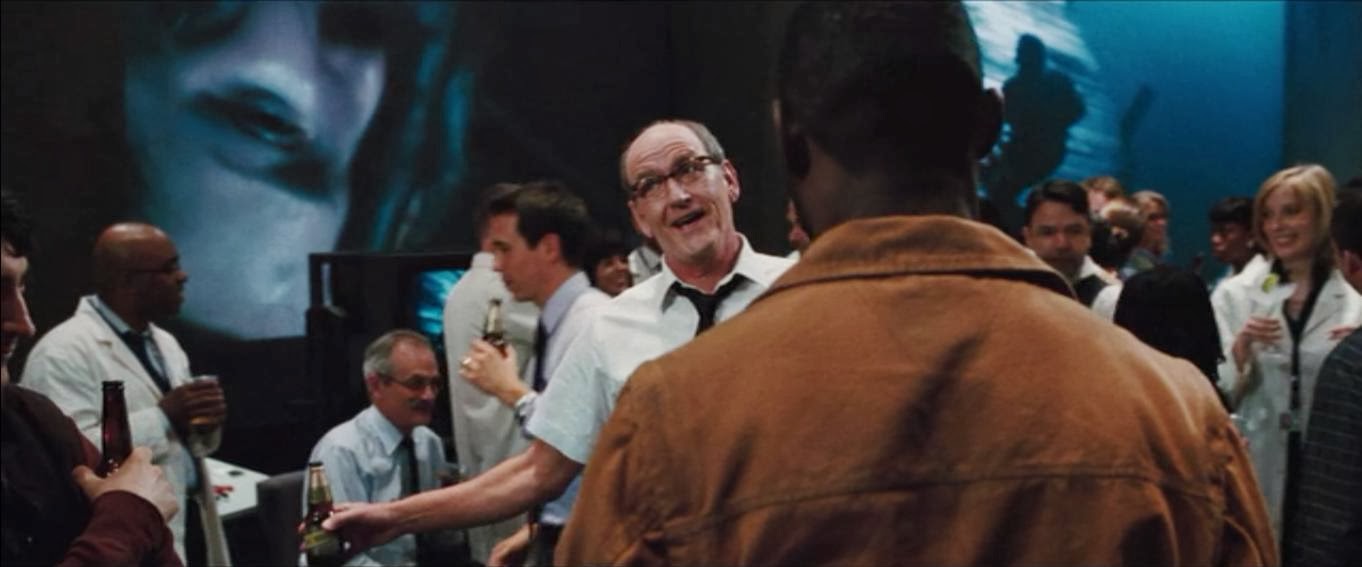
The scene begins with our “upstairs” heroine, Dana (Kristin Connelly), dragging herself out of a lake after barely escaping a zombie attack in a sinking RV. She collapses on a dock and tries to catch her breath while being overwhelmed by the terror of her evening. Right as we think she may be safe, the lead zombie, Judah Buckner, attacks her. Suddenly, we cut to a video screen image of the attack and the song “Roll with the Changes” by REO Speedwagon begins playing. A party is going on in the “downstairs” control room. Employees are flitting about between groups, laughing, gossiping, celebrating a job well done. They drink beer and toast to their success. Some talk about the event, some about overtime bonuses, others try to hook up with the opposite sex, and all the while the images of Dana being throttled by Judah Buckner play on the massive video screens, ignored by the group. The scene ends with Sitterson learning there was a technical problem with power supply from “upstairs.” Just as he is intrigued and concerned, a red phone rings, making it clear the party is over.

There are several elements to this scene exploring the idea we need to see violence to stay peaceful. The most important element is the song selection for the party. REO Speedwagon’s soft rock anthem, “Roll with the Changes” tells the story of a man looking to take his relationship with a woman to the next level. He implores her to join him and roll with the changes of their life. The song isn’t in the film because of its romantic elements, though. It’s there because of the chorus:

If you’re tired of the same old story
Turn some pages
I’ll be here when you are ready
To roll with the changes

These lyrics imply the story needs to be changed, and we need to roll with it. The film’s tired tale of doomed teens in the woods needs to be shaken up – we, as an audience, are over it. Having seen a slew of these horrors, there’s not much else left. Our desire for a different sort of violence is growing. If we don’t get something new soon, we will blow.

While the song selection dominates the party scene, other elements also contribute to the scene’s meaning. After the party environment is established, the video screen showing the attack on Dana is in nearly every shot, hovering over the proceedings with an ominous blue-gray glow. It’s a reminder to us that we have become desensitized to the violence we see. There is nothing amusing or entertaining about violence being perpetrated on another human being, yet the employees laugh and drink as if the images around them should be celebrated. The constant exposure to violence has numbed us to its impact, which keeps us from giving in to our darker impulses.

Since the movies provide us an outlet for our violent thoughts, our darker impulses are replaced by other, more socially acceptable forms of violence. This is seen in a choice moment of the party scene. We witness Hadley being congratulated on a job well done. A couple employees kiss his ass, and he not-so-humbly shines them on. As he hears them go on about the RV crash, he becomes reflective, and finally says, “I just think it would have been cooler with a merman.” His desire for a better violent payoff is more powerful than any human empathy with the innocent kids he has coldly slaughtered. Watching and creating these voyeuristic moments of violence, from his perspective, keep the Old Gods at bay, which keeps truly destructive violence from entering the world.

The Cabin in the Woods is a horror film with more on its mind than bloodletting, despite the fact that it is, indeed, a remarkably gory film in its last act. It wants to make a bolder statement about why people watch horror films, and most importantly, what happens to us when we don’t attempt to satisfy our violent nature. The answer to that question is devastating. Without horror films, without horror fiction, without quality horror fiction, man is unsatisfied and struggles to resolve his fears of death. Yet, we need to change the same old story to keep the monster at bay. We need to roll with the changes.

Works Cited

The Cabin in the Woods. Dir. Drew Godard. Perf. Richard Jenkins and Bradley Whitford. Lionsgate, 2011. DVD.

Cronin, Kevin. "Roll with the Changes." Rec. Mar. 1978. You Can Tune a Piano, But You Can't Tuna Fish. REO Speedwagon. Kevin Cronin and Gary Richrath, 1978. MP3.

Saturday, August 24, 2013

Use the Bathroom Wisely and Other Study Tips

Everyone knows what homework is, even those who refuse to do it. It’s those neat little activities or week long projects your teachers give you at the end of class you have to take home, slave over, and turn in the next day.

Homework is work. But it should not only be reduced to worksheets, projects, and things that must be turned in.

Teachers often tell students to study. Yet, without a specific thing that must be turned in, students often don’t know where to begin, or even the first clue as to what study actually means. No doubt you know the dictionary definition of study, but the practical definition? That’s a different set of notes.

Study means carving out time in your schedule every single day to review anything you covered in class, not just for the current day, but for the previous weeks, too. This includes notes, handouts, returned assignments, class readings from the textbook, and your personal annotations.

Study means getting a group of friends together to talk about the material in your shared classes. With social networking sites like Facebook, Skype, and Google +, you have a large array of options that don’t necessarily require you to meet up at the public library or the Denny’s down the block.

Studying this way probably sounds alien, especially since you live in a culture that constantly tells you that “school stays at school” and “home stays at home.” But talking about what you’re learning with anyone may make the difference between the grade you have and the grade you want.

So, studying is different than homework, and definitely has benefits, but how do you do it? Here are some tips:

1.       Make time.

If you do not make time to study, you will not study.

Plan a minimum of 20 minutes of study time per day (even on weekends) for the classes that require the most of you (English, math, history, science). Make an effort to plan your study time around those periods you are tired, or winding down after a long day. Here are the times of the day most students seldom consider using:

  • Wake up 30 minutes earlier and study then. You might be groggy at first, but you will adapt. And you won’t be as likely to fall asleep, especially if you’re getting a good night’s sleep (you are, aren’t you?).
  • Meal times are helpful because, unless you’re having a family dinner, you are sitting around doing nothing more important than shoveling food into your mouth. The act of eating keeps you awake and, depending on what you’re eating, can even stimulate your mind.
  • Use your bathroom time! The bathroom is the place you have privacy for about 15-20 minutes, and seriously, what else are you going to do while squeezing one out? Stare at the walls? Most people read while they’re on the toilet, so why not notes? More productive than that latest Willy Wonka meme on Facebook.
2.       Eliminate distractions

When you study, you need to be studying. It is probably safe to assume that when most students are “studying,” they are also listening to music, keeping track of their smartphones, yelling at their kid brothers and sisters to keep it down, texting friends, and watching TV in the background. If your mind is divided between multiple tasks, it will not be able to do any effectively.

Find a spot where you can study without a lot of distractions. Turn off the cell phone. Avoid the TV. Listen to music that doesn’t have words, or at least music you are familiar with. This might be tough at first, but it gets easier with practice.

3.       Reward yourself

You are not a robot; you are a human being (although, you might want to check). So, take breaks when you study. Read and review those notes and textbooks for 20-30 minutes, then take a break and reward yourself. Turn that cell phone back on and check Twitter. Watch an episode of Breaking Bad. Text a friend. Play a round of Battlefield. Then, if you have more studying to do, shut everything down again, and get back to it.

Studying should not be an activity that kills you, crushes your spirit, or absorbs every ounce of your time. If you plan time every day, you will not only see benefits in the classroom, you will discover yourself enjoying those preferred activities so much more.

So, find a bathroom, take a seat, and get studying!

Saturday, August 10, 2013

The Importance of Annotation

Annotating, or marking up, a text is one of the most important activities you will do this year. It is important that you get a strong grasp on what it means, why you should do it, and how to do it.

What is Annotation?

Annotation is not simply underlining or highlighting a text. It is a conversation you are having with the text you are reading. This involves writing notes, making comments, circling important information, and noting patterns and recurring ideas. When you are done annotating, you should be able to look back at what you've done and get a clearer picture of what a text means, and how it achieved its purpose.

Why Annotate?

Annotating is a powerful way to engage with, focus on, and remember what you read. It requires that you carefully spend time digesting a text instead of rushing your way through it like a dog eating a bowl of Pedigree. Becoming a more powerful reader has many benefits, least of all being successful in class.

How To Annotate?

There are many ways to annotate a text, so work on a system that helps you. In the "Downloads" section, you will find a handout to assist you, as well as in the AP Survival Guide. Here's a link to an article that goes more in-depth (on page 3, there's an example).

Take a look at "annotation examples" on Google, and select the Images feature; you'll discover lots of images showing you a variety of annotation styles.

Here are some basic tips:

1. Underline any passages you feel sound thematically important. These are usually very well-written, often profound-sounding statements.

2. Summarize important pieces of information in the margins.

3. Write connections to other stories, films, music, and art that the text reminds you of.

4. Note important uses of symbol, metaphor, or irony.

Lastly, you won't be able to write in every book that you get in school, so consider using Post-It notes. They are remarkably helpful and can be removed when you no longer need them. Also use a pencil, because your ideas might change or shift focus through the reading, making the ability to erase quite valuable.

Alright, time to get reading with those pencils out!